

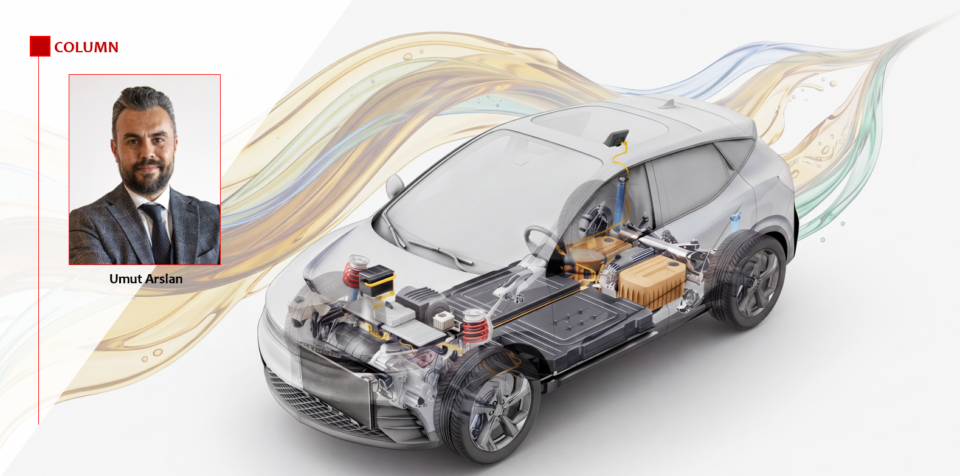
Electric vehicles do not consume engine oil. That is true. Yet the same electric vehicle faces a lubrication challenge far more complex than that of an internal combustion engine (ICE) vehicle. This is because an e-fluid is no longer responsible only for protecting moving parts from wear; it must also cool electric motor windings, lubricate gears, prevent damage to copper coils, and maintain the correct level of electrical conductivity in systems operating at hundreds of volts. All of these functions must be delivered by a single fluid.
Much of the lubricant industry’s response to the EV transition can be summarized as follows: “The engine oil market will shrink, and we will adjust accordingly.” This assessment is not wrong, but it is incomplete. The real question is: Who will develop, test, and validate this new generation of e-fluids?
A Question: What Does an e-Fluid Do in an Electric Vehicle?
Perhaps a better way to ask the question is: What happens if an EV has no e-fluid?
An electric motor typically operates between 6,000 and 15,000 rpm. High speed, high torque, and high temperatures are inevitable. To manage this heat, most modern Electric Drive Unit (EDU) designs have adopted a “wet motor” architecture, in which the same e-fluid lubricates the gearbox and directly cools the electric motor. The fluid passes through the rotor shaft and, driven by centrifugal force, reaches the winding ends to remove heat.
In this architecture, e-fluid is no longer merely a maintenance product; it has become a functional component of the system itself. An e-fluid with poor thermal conductivity reduces vehicle range. An improperly formulated fluid can corrode copper windings. Such corrosion can directly result in motor failure.
Three Fundamental Contradictions of Conventional Lubricants
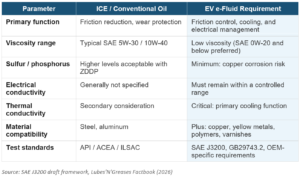
One of the lubricant industry’s most established additives, ZDDP (Zinc Dialkyldithiophosphate), has served as a primary anti-wear additive in ICE systems for decades. In EVs, however, it presents significant challenges:
ZDDP contains active sulfur. Active sulfur can chemically attack copper winding surfaces. The resulting corrosion degrades electromagnetic performance and may generate conductive by-products capable of bridging insulation gaps.
Certain calcium- and zinc-based metallic additives commonly used in conventional automatic transmission fluids can adversely affect electrical conductivity. In high-voltage systems, this may lead either to current leakage or static charge accumulation.
The ICE principle of “higher viscosity equals better protection” is effectively reversed in EVs. Higher viscosity increases churning losses in high-speed gears and reduces driving range. Conversely, excessively low viscosity may fail to provide an adequate lubricant film during low-speed, high-torque operation.
These three contradictions must be solved simultaneously. Conventional formulation approaches are insufficient for this task.
ICE Oil vs. EV e-Fluid: Key Parameter Comparison
The Standards Gap: Risk or Opportunity?
In ICE engine oils, decades of accumulated knowledge exist through specifications such as API SN Plus, ACEA C5, and ILSAC GF-6. Once a formulation meets these standards, it can be confidently introduced to the market. The same level of maturity does not yet exist for EV e-fluids.
Since 2022, the SAE J3200 task force has been developing test methodologies for EDU fluids. Several international lubricant manufacturers have already introduced their own EDU specifications. This reveals an interesting reality: lubricant suppliers are being forced to develop standards before OEMs have fully completed them. Meanwhile, major OEMs in Japan and South Korea are conducting much of this work internally, creating closed knowledge ecosystems.
Investing in a field where standards are still evolving may appear risky. However, once standards are established, delayed investment often becomes a permanent competitive disadvantage.
For Türkiye, the implication is clear: if domestic lubricant manufacturers do not build e-fluid development and testing capabilities today, they risk remaining merely consumers in the future EV market.
Oil Analysis Remains Essential
Capacity building extends beyond formulation laboratories. Significant work is also required in field monitoring, as oil analysis must evolve to evaluate e-fluid performance.
In ICE applications, oil analysis served as the equipment’s “blood test”—the most reliable way to assess internal condition. In EVs, it retains this role while incorporating additional parameters:
Electrical conductivity monitoring: Oxidation products and metallic contaminants generated during service can alter conductivity over time. These changes can be tracked using ASTM D2624 and emerging EV-specific methodologies.
Copper particle analysis: Rising copper concentrations detected through ICP-OES (ASTM D5185) may serve as an early warning sign of winding corrosion.
Viscosity shift monitoring: Measuring viscosity at both low and high temperatures indicates whether the e-fluid remains within its intended performance window.
In ICE systems, oil analysis supported maintenance decisions. In EVs, it may increasingly support safety-critical decisions, including those related to electrical integrity and fire risk.
Conclusion
The statement “Electric vehicles do not need engine oil” is both true and potentially misleading. It is true because the consumption associated with traditional ICE engine oils is indeed disappearing. It is misleading because it distracts the industry from the more important question.
The answer to that question may be the most significant engineering challenge facing the lubricant industry over the next decade. For manufacturers in Türkiye to provide credible technical solutions, investment in formulation expertise, testing infrastructure, and standards monitoring must begin now.
Rather than celebrating the decline of conventional engine oil, the industry should be asking what kind of e-fluid will replace it. And those who fail to ask that question today may find themselves purchasing the answer from others tomorrow.
Kaynakça
[1] Shore, J.F. & Kadiric, A. (2025). Optimization of Electric Vehicle Drivetrain Fluid with a New System-Level Approach. Tribology Transactions, 68(3), 668-689. https://doi.org/10.1080/10402004.2025.2488799
[2] Lubes’N’Greases. (2026). Electric Vehicles: Lubricant Trends. Lubes’N’Greases Factbook 2026. https://www.lubesngreases.com/factbook/fb-article/electric-vehicle-lubricants-trends/
[3] Guerrero, M.A. et al. (2022). Electrical Compatibility of Transmission Fluids in Electric Vehicles. Tribology International. https://doi.org/10.1016/j.triboint.2022.107448
[4] SAE International. (2022). SAE J3200: TC3 Electric Drive Fluids Task Force. SAE International, Warrendale, PA.
[5] Plant Engineering. (2025). Design Requirements and Challenges for Single-Use EV Fluids. https://www.plantengineering.com/design-requirements-and-challenges-for-single-use-ev-fluids/
[6] Kapoor, M. et al. (2025). A Comprehensive Review of Lubricant Behavior in ICE, Hybrid, and Electric Vehicles. Lubricants, 14(1), 14. https://doi.org/10.3390/lubricants14010014
[7] Fuels & Lubes Asia. (2024). Global Drive for Standardisation in EV Fluids and Technologies. https://www.fuelsandlubes.com/fli-article/global-drive-for-standardisation-in-ev-fluids-and-technologies/
[8] Q8Oils. (2024). Electric Vehicles Require Specialized EV Lubricants. https://www.q8oils.com/automotive/ev_lubrication/
[9] ASTM International. (2023). ASTM D5185: Standard Test Method for Multielement Determination of Used and Unused Lubricating Oils. West Conshohocken, PA.
[10] Prestone / EV Engineering & Infrastructure. (2025). New Standards Drive Advances in EV Thermal Management Fluids. https://www.evengineeringonline.com/new-standards-drive-advances-in-ev-thermal-management-fluids/
[11] Arslan, U. (2021). Kestirimci Bakımda Yağ Analizinin Önemi. Madeni Yağ Dünyası / Lubricant World. https://lubricant-world.com/kestirimci-bakimda-yag-analizinin-onemi-2/
#ElectricVehicles
#EMobility
#Lubricants
#ThermalManagement
#LubricantWorld