
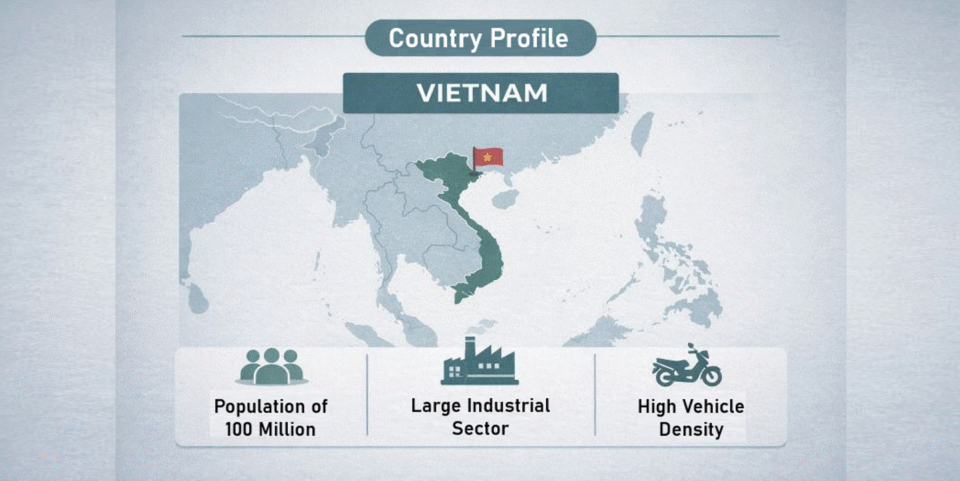
Vietnam has quietly but steadily secured its place on the global manufacturing map in recent years. As China-centric supply chains diversify, the country is emerging as a major production and consumption hub in the Asia-Pacific region. With a population approaching 100 million and an average age of around 32, Vietnam is not only a manufacturing base but also a large and youthful domestic market. Rapid urbanization and rising income levels are directly driving industrial activity and mobility.
🏭 Industrial and Manufacturing Ecosystem
Industrial production accounts for a significant share of Vietnam’s economy.
Key sectors include:
- Electronics and electrical equipment
- Automotive and component manufacturing
- Textiles and metalworking
- Export-oriented assembly and production facilities
This structure translates into sustained and recurring demand for hydraulic oils, industrial lubricants, and metalworking fluids.
🚗 Vehicle Fleet and Mobility Dynamics
One of Vietnam’s most distinctive features is its exceptionally high motorcycle density. The country is estimated to have more than 50 million motorcycles—more than the total vehicle fleet of many European nations. The number of passenger cars and light commercial vehicles is also rising steadily each year.
This reality creates a volume-driven market for:
➡️ engine oils
➡️ transmission fluids
➡️ maintenance and service products
🛢️ What Does This Mean for the Lubricants Market?
Vietnam’s market is characterized by:
- high price sensitivity
- steadily growing overall consumption
- the coexistence of local producers and global brands
Given the size of the motorcycle fleet and frequent maintenance cycles, per-vehicle engine-oil consumption may be relatively low, but in aggregate the market is substantial.
Vietnam therefore stands out as an attractive destination for companies prioritizing continuity and scale over premium margins.
🌏 Trade Environment and Regional Advantages
Vietnam benefits from:
🟢 strong integration with ASEAN trade networks
🟢 well-developed maritime logistics
🟢 openness to foreign firms through regional industrial exhibitions and trade fairs
These features position the country not only as a domestic market, but also as a gateway to Southeast Asia.
⚠️ Market Realities and Risks
As with any emerging market, Vietnam presents certain challenges:
- regulations can change rapidly
- understanding local business culture is essential
- price competition is intense
That said, the overall picture points to a predictable, manageable, and relatively stable market environment. The right local partnerships play a critical role in long-term success.
🔍 In Summary, the Vietnamese Market Offers:
- a young and sizable population
- strong manufacturing capacity
- extremely high motorcycle density
- a growing vehicle fleet
- volume-driven demand for lubricants
📌 Conclusion
Vietnam may appear geographically distant for Turkish companies today. However, with its expanding industrial base, mobility patterns, and lubricants consumption potential, it has all the makings of becoming a familiar and strategically important market in the years ahead.
#Lubricants #IndustrialMarkets #GlobalTrade #SectorAnalysis #Economy