

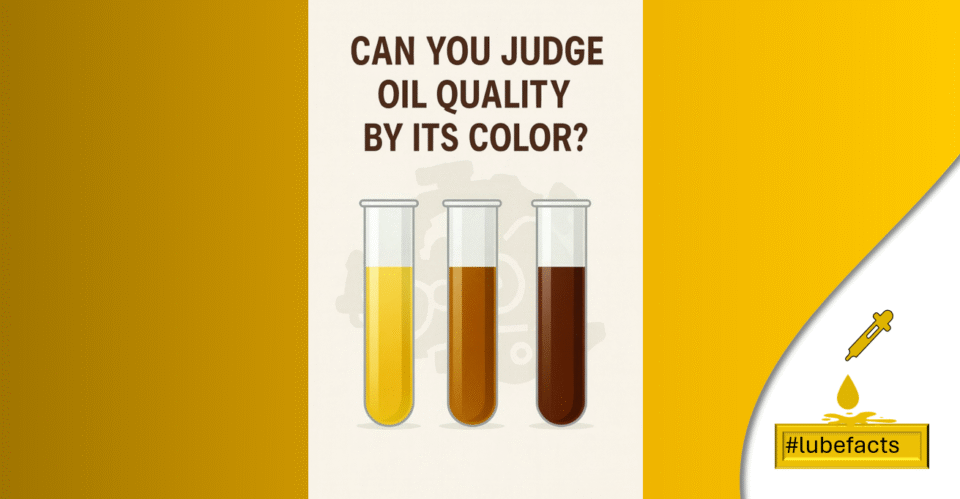
Many users of engine or industrial oils assume that the color of the oil indicates its quality. Comments like “The oil has darkened, so it must be degraded” or “The oil still looks clean, no need to change it” are technically incorrect.
🔬 Why is color alone not sufficient?
The color of oil is influenced by base oil type, additives, operating temperature, and contaminants. Detergent-dispersant additives suspend dirt in the oil, which can cause it to darken quickly — in fact, this shows the oil is doing its job. Some synthetic oils may appear darker or have different tones even when first used.
⚙️ How is real quality determined?
Parameters such as oxidation level, viscosity change, TBN (Total Base Number), TAN (Total Acid Number), water, and particle content are measured through laboratory analysis. Especially in engine oils, darkening is not always negative; on the contrary, it can indicate that the oil is effectively holding contaminants.
📊 Conclusion:
Oil color is only a superficial clue and not a definitive indicator of oil life or quality. True evaluation can only be achieved through oil analysis.
#OilAnalysis #LubricationQuality #EngineOils #IndustrialMaintenance #LubeFacts