
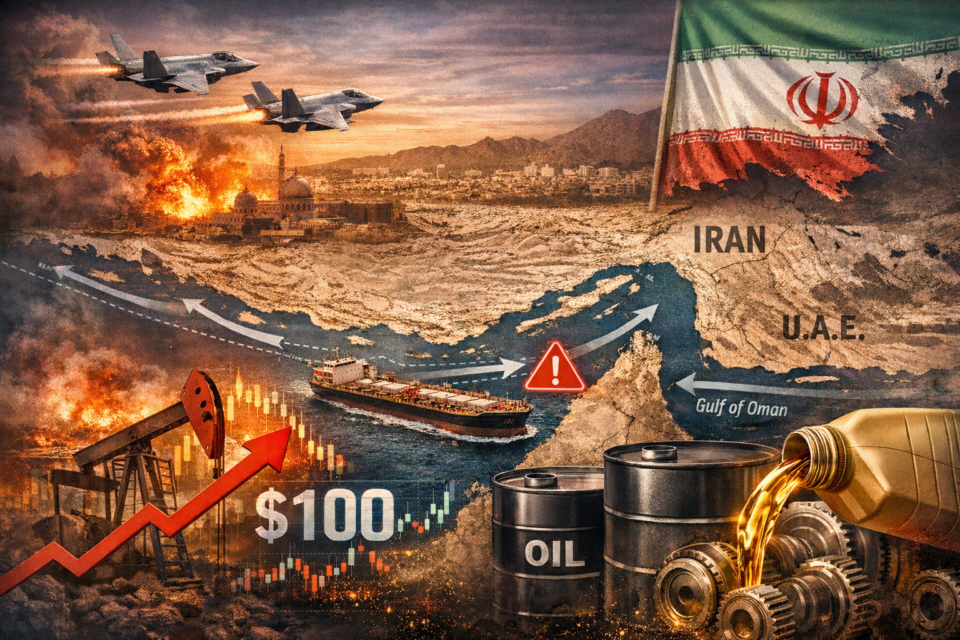
Following the US–Israel operation, Iran-related geopolitical tensions have triggered sharp volatility in oil prices and energy markets. The security risk in the Strait of Hormuz is affecting crude oil, base oil, and petrochemical supply chains, while in energy-importing countries such as Türkiye, cost, supply, and financing risks for the lubricants industry have resurfaced.
A New Risk Premium in Global Energy Markets
After the military developments over the weekend, the first reaction in global markets was seen in energy prices. Oil prices in particular surged sharply at Monday’s opening. The main reason is the security risk in the Strait of Hormuz, through which about 20% of global oil supply passes.
Approximately 20 million barrels of crude oil and significant LNG shipments transit this narrow passage daily.
Even without a physical closure,
- Rising insurance premiums
- Slower tanker traffic
- Higher costs of alternative routes
automatically create a “geopolitical risk premium” in global pricing.
This situation affects not only crude oil but also refined products, base oils, and petrochemical intermediates.
Where Are Oil Prices Heading?
Energy analysts are considering three scenarios:
1️⃣ Short-Term Tension
Temporary price spike followed by gradual normalization. Brent crude could stabilize in the 80–90 USD range.
2️⃣ Controlled but Prolonged Tension
Risk premium becomes permanent. Freight, insurance, and financing costs remain high.
3️⃣ Supply Disruption Scenario
If actual disruption occurs in the Strait of Hormuz, triple-digit oil prices become possible.
Currently, markets are not pricing in the third scenario; however, even the “possibility” is enough to increase volatility.
Critical Issues for the Turkish Economy
Türkiye is a net energy importer. Therefore, every increase in oil prices:
- Expands the current account deficit
- Raises demand for foreign currency
- Strengthens inflationary pressures
- Pushes industrial costs higher
Cost inflation driven by energy prices creates chain pressure on industrial production.
For Türkiye, already exposed to risks from the Russia–Ukraine war, Black Sea logistics, and Syria-related tensions, this development adds a new layer of vulnerability.
Specific Impacts on the Lubricants and Petrochemical Industry
Here, the issue is no longer a general energy matter, but has transformed into a direct sectoral issue.
1️⃣ Base Oil Supply and Refinery Margins
Base oil production is directly linked to refinery configuration and crude oil costs. Rising crude prices:
- Pressure refinery margins
- Increase base oil costs
- Heighten spot market volatility
Group I and Group II base oil shipments, especially those linked to the Middle East, may face freight risks.
2️⃣ Additives and Petrochemical Chain
Lubricant additives largely derive from petrochemical intermediates. Rising energy prices affect:
- Ethylene and propylene derivatives
- Solvent-based products
- Packaging costs
This raises not only base oil but the entire formulation cost.
3️⃣ Short-Term Risks for the Industry
- Raw material price increases
- Pressure for price revisions
- Inventory valuation differences
- Cautious purchasing behavior among dealers and distributors
For firms with weak liquidity management, volatile periods pose serious risks.
4️⃣ Medium-Term Opportunities
Every crisis also offers repositioning opportunities:
- Firms with strong inventory management gain advantage
- Producers with long-term supply contracts secure competitiveness
- Demand may rise for high-performance products with longer oil change intervals
- Energy efficiency emphasis becomes stronger
The “total cost of ownership” (TCO) argument can be marketed more effectively.
Investor and Industry Response
Investors:
- Volatility in energy stocks
- Temporary capital outflows from emerging markets
- Currency fluctuations
Industry:
- Tendency to keep inventories at minimum levels
- Delaying price revisions
- Cautious stance in new investment decisions
In the lubricants industry, exporters will try to balance currency advantages against cost disadvantages.
Long-Term Strategic Outlook
If such geopolitical risks become permanent, a “new normal with high risk premiums” may emerge in energy markets.
For the industry, three strategic priorities stand out:
- Alternative geographies for base oil supply
- Product development focused on energy efficiency
- Financial risk hedging mechanisms
For energy-dependent economies like Türkiye, energy prices are no longer just a cost factor but a strategic parameter of competitiveness.
Conclusion – Alarm or Adaptation Period for the Industry?
Developments in the Strait of Hormuz have not yet turned into an actual supply disruption. However, market psychology triggers price movements before supply cuts occur.
For the lubricants industry, this period requires revisiting:
- Cost discipline
- Supply security
- Cash flow management
- Strategic pricing
Geopolitical waves may be temporary. But for companies caught unprepared, the consequences can be permanent.