
Tayfun Yılmaz – Vario Grease General Manager
Open gear systems are among the most critical industrial applications operating under heavy loads, low speeds, and harsh environmental conditions. They are used primarily in the cement industry, as well as in mining, energy, iron and steel, ports, and wire rope systems. Traditionally, the performance of the greases used in these systems has been evaluated mainly in terms of load-carrying capacity (Extreme Pressure – EP). However, today parameters such as energy efficiency, equipment life, and maintenance costs show that the coefficient of friction is at least as important as EP performance.
In this article, the effects of friction will be discussed without compromising high EP performance in open gear greases; additionally, the influence of thickener (soap) types on system performance will be examined. The results demonstrate that high-performance systems can be developed through the right base oil architecture, appropriate thickener selection, and additive synergy.
Open gear mechanisms operate under high surface pressures and mostly within the boundary lubrication regime. Therefore, the greases used are expected to provide the following characteristics:
- High load-carrying capacity (EP)
- Wear control (AW)
- Adhesion to surfaces
- Resistance to water and environmental factors
- Thermal and oxidative stability
In the traditional approach, performance was largely evaluated based on EP values. However, field observations show that:
- High EP performance alone is not sufficient to maximize equipment life.
- A high coefficient of friction reduces system efficiency by causing energy losses, heating, surface fatigue, and micro-damage.
Therefore, the modern approach is defined as “achieving high load-carrying capacity together with low friction.”
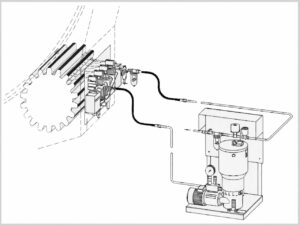
Tribological Balance in Open Gear Greases
In open gear greases, three key parameters are directly interrelated:
- EP performance
- Wear resistance
- Coefficient of friction
In conventional systems, as EP increases, friction increases; as friction decreases, load-carrying capacity drops. EP additives form a chemical resistance on the surface under heavy loads, increasing the coefficient of friction. On the other hand, additives that minimize friction typically cannot offer adequate film strength under extreme pressure. Modern grease production technologies aim to achieve both low friction and high load-carrying capacity without disrupting this balance. This is a challenging yet critical equilibrium from a formulation engineering perspective.
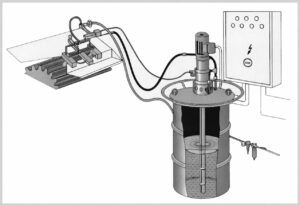
Formulation Engineering Approach
Base Oil Architecture
A suitable combination of paraffinic, naphthenic, and synthetic base oils provides:
• Lubricating film strength
• Stabilization of friction
• Improved thermal performance
Solid Lubricant Technology
Solid lubricants such as graphite and MoS₂:
• Carry loads under boundary lubrication regime
• Provide low shear resistance between surfaces
Additive Synergy
• EP additives: load carrying
• AW additives: wear control
• Friction modifiers: friction reduction

Effect of Thickener (Soap) Types
Lithium and Lithium Complex
• Moderate EP performance
• General-purpose use
Aluminum Complex
• High tackiness
• Good water resistance
• Compatibility with spray systems
Calcium Sulfonate Complex (CSX)
• Very high EP
• Excellent water resistance
• Natural AW properties
Bentonite
• High temperature resistance
• Low mechanical stability
Expected Values for Open Gear Greases
ANALYSIS |
TEST METHOD |
EXPECTED VALUE |
DESCRIPTION |
| Base Oil Viscosity (40 °C) | ASTM D445 | 500 – 3500 cst | Formation of a strong lubricating film to carry heavy loads |
| Four Ball EP | ASTM D2596 | >620 kg | Prevents welding of gear surfaces under extreme pressure |
| Four Ball AW | ASTM D2266 | <0.5 mm wear scar | Controls metal loss and micropitting |
| Dropping Point | ASTM D2265 | 180 °C – 275 °C | Maintains grease structure and prevents flow at high temperatures |
| Water Washout Resistance | ASTM D4049 | 10% – 35% | Resistance to outdoor conditions and water |
| Copper Corrosion | ASTM D130 | Max 1b | Passivity and protection for yellow metals |
| FZG Gear Test | DIN 51354 | >12 | Surface scuffing resistance |
Field Performance
- Long-term stable operation
- Low wear
- Extended maintenance intervals
- Long service life
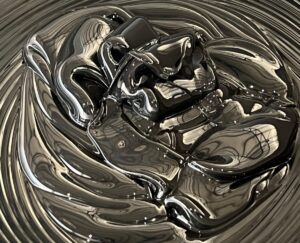
Aluminum Complex Soap
Why is it widely used in open gear greases?
Why is this combination preferred?
The high adhesion and retention properties of aluminum soap-based greases stem from the aluminum ion’s (Al³⁺) strong and versatile bonding capability. Compared to metals like lithium and calcium or bentonite-type thickeners, aluminum can form more bonds, creating bridges between fatty acids and resulting in a more dense and three-dimensional structure. This structure enhances the grease’s internal cohesion and helps it adhere more strongly to metal surfaces. Therefore, aluminum soap-based greases stand out in applications where staying on the surface is critical, such as open gears.
Aluminum complex soap
• NLGI 00 – 000
• Base oil viscosity: 500 – 3500+ cSt
• Easy pumpability
• Homogeneous distribution
• Compatibility with spray systems
• Strong adhesion to surfaces
• Water resistance
• Film stability
• Thick oil film
• No break-off under load
• Prevention of metal-to-metal contact
These chemical properties become especially critical under low-speed conditions.
Conclusion
This study shows that performance in open gear greases should be evaluated not only by EP but also by friction and system stability.
The right system is achieved by simultaneously optimizing the trio of:
- Base oil
- Thickener
- Additives