

What You Need to Know to Choose the Right Engine Oil
Engine oil is one of the most critical components for the healthy operation of the engine; it is the heart of a vehicle. Selecting the right oil not only extends engine life but also improves fuel efficiency, reduces maintenance costs, and enhances driving comfort and performance. By contrast, using the wrong oil can result in excessive wear, reduced performance, serious malfunctions, and significant financial losses. For this reason, vehicle owners must be both informed and cautious when making their choice.
In today’s market, rising prices, the prevalence of counterfeit products, and risks of technical incompatibility make this decision even more crucial. Opting for unlicensed, unbranded, or non-OEM-approved oils may seem like a short-term saving, but often leads to cascading costs in the future. All of this underscores the importance of choosing the right oil and sourcing it from reliable suppliers under proper conditions more than ever.
The Importance of Engine Oil for Vehicle Health
Engine oil forms a protective film between moving parts, reducing friction, preventing wear, and dissipating heat to keep the engine cool. It also suspends dirt and deposits, helping maintain cleanliness, while creating a barrier against corrosion.
Over time, however, oil becomes contaminated, loses viscosity, and its protective qualities diminish. When this happens, engine parts make direct contact, wear accelerates, and overheating can occur. Dirty oil may also form sludge that clogs channels, leading to costly breakdowns. Regular use of the correct type of high-quality oil is therefore essential for quiet, efficient, and long-lasting operation. In modern engines, improper oil selection can cause serious damage to sensitive systems such as turbochargers, particulate filters, and variable valve timing.
Types of Engine Oil
Engine oils are classified into three main groups according to their production technology and chemical structure: mineral, synthetic, and semi-synthetic oils. Each type has distinct advantages, disadvantages, and areas of application.
- Mineral Oils: Affordable and commonly used in older engines. They break down faster at high temperatures and require more frequent changes.
- Synthetic Oils: Engineered in laboratory environments, they deliver superior performance, maintain stability under extreme conditions, and allow longer drain intervals. Best suited for modern engines, though they come at a higher cost.
- Semi-Synthetic Oils: A blend of mineral and synthetic bases, offering a balanced compromise between price and performance. Ideal for everyday driving needs.
What Is Viscosity?
Viscosity refers to an oil’s resistance to flow. In engine oils, it indicates how easily the oil circulates at both low and high temperatures. The SAE (Society of Automotive Engineers) defines viscosity grades, typically expressed in the format “XW-XX” (e.g., 5W-30, 10W-40). The first number with “W” represents cold-weather fluidity, ensuring quick lubrication during startup. The second number reflects high-temperature resistance, maintaining a protective film under heat and load.
Selecting the correct viscosity guarantees smooth cold starts and reliable protection at operating temperatures. Choosing the wrong grade, however, can lead to excessive friction, accelerated wear, and overheating. For this reason, climatic conditions and manufacturer recommendations are critical factors in determining the right viscosity.
What is OEM Approval, and Why Is It Important?
OEM (Original Equipment Manufacturer) approval is a technical guarantee that an engine oil has successfully passed rigorous tests conducted by a specific vehicle manufacturer and is fully compatible with that engine type. These tests cover not only overall performance but also manufacturer-specific criteria such as deposit control, thermal oxidation resistance, wear protection, oil consumption, fuel economy, and long-term engine cleanliness.
When an oil is labeled “OEM approved,” it means the product has undergone and passed both laboratory and field tests by the manufacturer, earning official certification. The phrase “meets OEM requirements” indicates that the oil has not been tested or approved by the manufacturer. Using non-approved oils, especially in newer-generation engines, significantly increases the risk of malfunction and may void the vehicle’s warranty.
OEM approvals are typically listed on the back label of oil containers with codes such as “MB-Approval 229.52” (Mercedes-Benz), “VW 504 00/507 00” (Volkswagen), or “BMW Longlife-04” (BMW). The safest and most accurate choice is to select an oil that carries the OEM code specified in your vehicle’s owner’s manual or on the oil cap.
Label Reading and API/ACEA Classifications
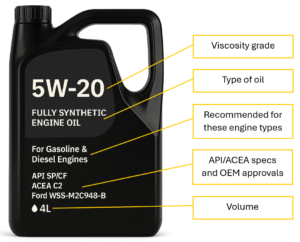
The labels on engine oil containers contain important information about the oil’s technical properties and suitability. Reading the label correctly is key to choosing the right oil.
- Basic Information on the Label
- Viscosity Grade (SAE): For example, 5W-30, 10W-40. This indicates the oil’s fluidity in cold and hot conditions.
- API/ACEA Classifications: Indicates the oil’s international quality and performance standards.
- OEM Approvals: Official approval codes from the vehicle manufacturer (e.g., VW 504 00, MB 229.52).
- Additional Information: Information such as low ash (low SAPS), biodegradability, environmentally friendly designations, place of manufacture, and lot number.
- API (American Petroleum Institute) Classifications
API classifies engine oils into two main groups for gasoline and diesel engines:
- Gasoline Engines: Starts with the letter “S” (e.g., API SN, API SP). As the letter progresses (SJ, SL, SM, SN, SP), the oil’s suitability and performance for new-generation engines increase. API SP is the highest standard for current gasoline engines and offers low-speed pre-ignition (LSPI) protection.
- Diesel Engines: Starts with the letter “C” (e.g., API CK-4, CJ-4). It was developed for high-performance and emissions-controlled diesel engines.
- ACEA (Association des Constructeurs Européens d’Automobiles) Classifications
ACEA is a standard developed for European vehicles and is divided into three main categories:
- A/B: For gasoline and light diesel engines (e.g., ACEA A3/B4).
- C: For modern engines with particulate filters, with low ash content (e.g., ACEA C3, C4, C5).
- E: For heavy-duty diesel engines.
ACEA classes indicate the oil’s performance in criteria such as engine cleanliness, wear protection, and extended drain intervals.
- ILSAC and JASO Standards
- ILSAC: Fuel economy and emissions-focused standards for American and Japanese automobiles (e.g., ILSAC GF-6, GF-7).
- JASO: Japanese standards specifically for motorcycle oils (e.g., JASO MA, MA2, MB).
Sample Engine Oil Label
Below is a sample engine oil label and its descriptions:
Which Oil Should Be Preferred in Which Conditions?
The choice of engine oil depends not only on its type and viscosity but also on the vehicle’s operating conditions, engine design, and the prevailing climate. Below are key recommendations for selecting the right oil under different circumstances:
- Climatic Conditions
- Cold Climates: Oils with a lower “W” rating (0W-20, 5W-30) are recommended. They ensure rapid lubrication during cold starts and minimize wear.
- Hot and Humid Climates: Oils with higher viscosity grades (10W-40, 15W-40, 20W-50) maintain a stable protective film at elevated temperatures and prevent breakdown.
- Usage
- Urban, Stop-and-Go Traffic: Synthetic or semi-synthetic oils provide superior protection in congested traffic and short trips. Low-viscosity grades support quick lubrication and improved fuel economy.
- Long-Distance, High RPM Driving: Fully synthetic, high-temperature resistant oils (e.g., 5W-40, 10W-40) are ideal. They maintain stability under sustained heat and help keep the engine clean.
- Heavy-Duty, Commercial Use: High-viscosity, OEM-approved oils deliver stronger protection for engines operating under heavy loads.
- Vehicle Type
- Gasoline Engines: Oils such as 5W-30 and 10W-40 are generally suitable, with synthetic oils recommended for modern designs.
- Diesel Engines: Thicker oils (5W-40, 15W-40) help reduce soot buildup. For vehicles with diesel particulate filters (DPF), low-ash oils meeting ACEA C3 or C4 standards should be used.
- Turbocharged Engines: Fully synthetic oils with high thermal resistance (0W-40, 5W-40) are essential.
- Hybrid and LPG Vehicles: Low-viscosity, fuel-efficient oils (0W-16, 0W-20) are preferred.
- Older Model Vehicles: Mineral or semi-synthetic oils are often more suitable for engines with wider tolerances.
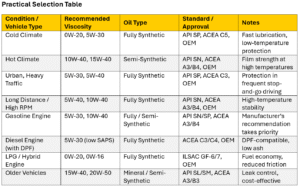
This table summarizes which oil should be preferred under different conditions. However, you should always prioritize the viscosity and standards specified in your vehicle’s owner’s manual.
Engine Oil Procurement Roadmap for Individuals and Companies
Engine oil is not just a liquid; it is a protective system that directly affects the engine’s lifespan, performance, and safety. Therefore, using reliable supply channels is just as critical as choosing the right oil itself. For individual users, trusted sales points and online platforms are the safest options, while for fleets and institutions, authorized distributors and direct agreements with manufacturers provide the most secure solutions.
Key factors to consider in engine oil procurement include purchasing from reliable sources, selecting approved products suitable for the vehicle and operating conditions, and conducting a proper price-performance evaluation.
In recent years, rising exchange rates and production costs have driven lubricant prices upward, pushing consumers toward cheaper alternatives. However, while short-term savings on oil may seem appealing, in the medium to long term, this can result in engine shutdowns, breakdowns, towing expenses, labor losses, and voided warranties. For this reason, price-performance evaluation should focus not only on the cost per liter but also on the product’s technical adequacy, OEM approval, and protective capacity.
- Engine Oil Procurement for Individual Users
For vehicle owners, engine oil is typically obtained through the following channels:
- Authorized Service Centers: Provide brand-specific oils approved by the manufacturer.
- Auto Spare Parts Stores: Offer oils that comply with API/ACEA classifications and provide various viscosity options.
- Fuel Stations: Many stations sell engine oil, serving as a practical source especially for urgent needs.
- Online Sales Channels: Reliable e-commerce platforms and manufacturer websites can be used for procurement.
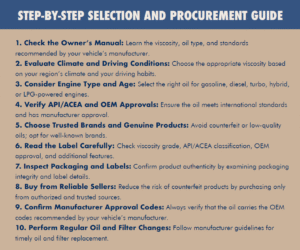
When purchasing oil for your vehicle, always check the packaging and label. To avoid counterfeit products, buy only from trusted sellers and pay attention to the viscosity and OEM approval codes recommended by the manufacturer.
- Engine Oil Procurement for Fleets, Companies, and Institutions
Corporate purchases differ from individual use, requiring bulk and long-term solutions:
- Authorized Distributors: Bulk purchases can be made through official distributors of major manufacturers.
- Direct Manufacturer Agreements: Fleets can establish long-term contracts with manufacturers, ensuring price advantages and consistent supply.
- Regional Suppliers: Local lubricant trading companies provide bulk sales to fleet and industrial customers.
- Corporate Service Packages: Some distributors offer oil change services, inventory management, and logistical support.
In corporate procurement, checking packaging and labels is essential to verify product authenticity. To mitigate the risk of counterfeit products, purchases should only be made from reliable sellers with strict attention to detail. Additionally, manufacturer-recommended viscosity grades and OEM approval codes must always be verified, as they are critical for vehicle performance and long-term durability.