
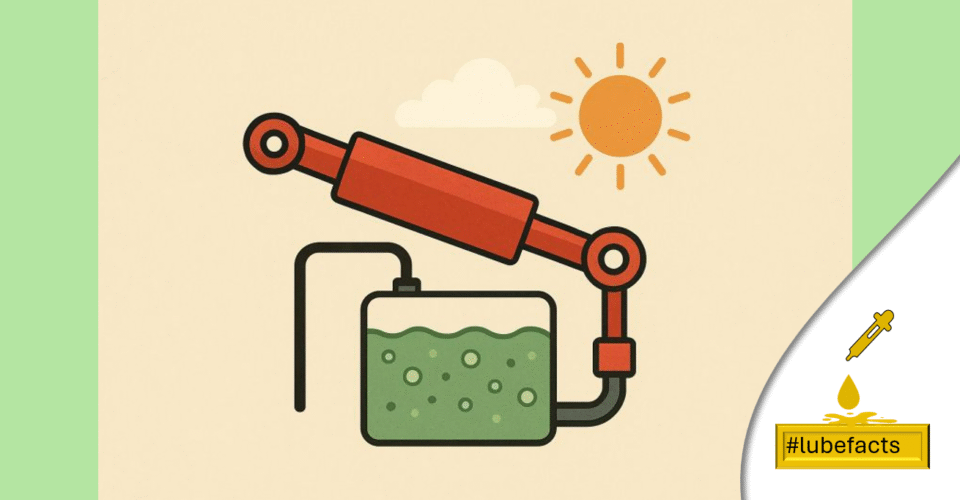
Hydraulic systems are highly sensitive to air entrainment due to high pressure, rapid flow, and turbulence. When air bubbles merge and become persistent, foam forms — and this can severely impair oil performance.
❓ Why Does Foaming Occur?
- External contamination such as water, oil degradation, or grease mixing
- Air ingress due to seal, pump, or system leakage (aeration)
- Excessive filtration removing antifoam additives
- Overuse of additives — too much antifoam can disrupt natural air release
- Incorrect oil selection or incompatible additive combinations
⚠️ Foam-Related Issues:
- Cavitation in pumps and instability in hydraulic operation
- Pressure drops reducing control precision
- Weakening of hydrodynamic lubrication film, increasing wear
- Misleading visual level indicators
- Reduced heat transfer, accelerating oxidation and oil degradation
🧪 Foam Testing: ASTM D892
This standard evaluates foaming tendency and stability in three stages:
- Stage I (24 °C): Foam generated with air for 5 minutes → tendency
- Stage II (93.5 °C): Re-tested under heat
- Stage III (24 °C): Stability assessed after cooling
Example results like 10/0, 50/0, 10/0 indicate “tendency/stability” values.
🧠 Strategic Control Methods:
🔧 Mechanical Measures:
- Rechecking seals and air ingress points
- System flushing
- Allowing rest periods in dry environments
- Careful oil top-ups to avoid splashing
🧪 Chemical Measures:
- Using suitable antifoam additives to prevent damage
- Preserving additive content before filtration
- Balancing excessive or insufficient additive use
🌿 Synthetic vs Mineral Oils
Synthetic oils (PAO, hydrocracked) generally offer higher surface tension, resulting in less foaming than mineral oils. However, formulation, additive compatibility, and operating conditions also play a key role.
#HydraulicOils #FoamingControl #LubricationEngineering #ASTMD892 #IndustrialMaintenance #LubeFacts