
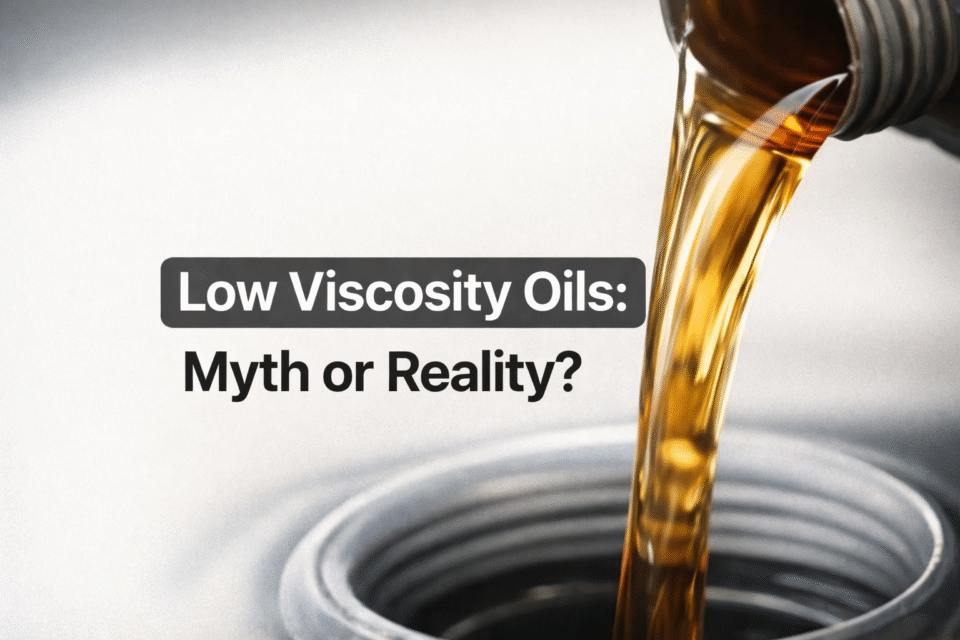
🔍 Let’s clarify some of the most common statements about motor oils and the actual facts 👇
1️⃣ “Thin oil doesn’t protect the engine.”
Fact: Modern engines are designed for faster lubrication and lower friction with low-viscosity oils.
What protects the engine is the oil’s resistance to film breakdown under high temperature/load (HTHS) and a strong additive package.
➡️ As viscosity decreases, additive technology improves.
2️⃣ “0W or 5W oils aren’t suitable for Turkey.”
Fact: The number before “W” only indicates cold flow properties—it’s not related to ambient temperature.
Engines are always cold at startup.
➡️ 0W oil flows faster at startup, reducing wear.
3️⃣ “Thin oil evaporates faster.”
Fact: Evaporation is mainly influenced by the engine’s mechanical condition and the oil’s volatility (NOACK), not viscosity.
➡️ High-quality base oil + proper additives → lower volatility is possible even with low-viscosity oils.
4️⃣ “Thin oil causes problems in summer.”
Fact: Warm-weather performance is determined by the number after “W” (e.g., 30 / 40 / 50).
➡️ 0W-30 and 10W-30 have the same viscosity at operating temperature.
5️⃣ “Thin oil has fewer additives.”
Fact: Quite the opposite.
Low-viscosity grades (e.g., 0W-20) require more advanced additive technology to maintain high HTHS values.
➡️ These oils are often more technologically advanced than traditional grades like 5W-40.
6️⃣ “Thin oil isn’t suitable for high-mileage engines.”
Fact: What matters is the OEM-recommended viscosity.
“High mileage = thick oil” is not a scientific rule.
➡️ The engine’s actual mechanical condition is the key factor.
💯 Many beliefs about low-viscosity oils are technically inaccurate.
Correct viscosity = Manufacturer recommendation + quality + technology.
#ViscosityFacts #LubricantScience #EngineProtection #LubeFacts